The Pi-Style Athenian Tetradrachm
After the defeat in the Peloponnesian War (431–404 BC), a long conflict in which Sparta and its allies defeated Athens and its empire, the Athenians gradually resumed the production of their silver coinage during the first half of the fourth century BC. However, they do not appear to have minted coins on anything close to the scale achieved before 415 BC 1.
By the 350s BC, the financial position of Athens remained difficult and required serious corrective measures, going even beyond those later proposed by Xenophon in his Poroi. The Athenians introduced important fiscal reforms, including the use of bronze token fractions. Bronze coinage was not welcomed by everyone. Aristophanes famously used bronze money as an image of declining standards, while works such as the Ecclesiazusae also reflect contemporary criticism and distrust of bronze coinage 2.
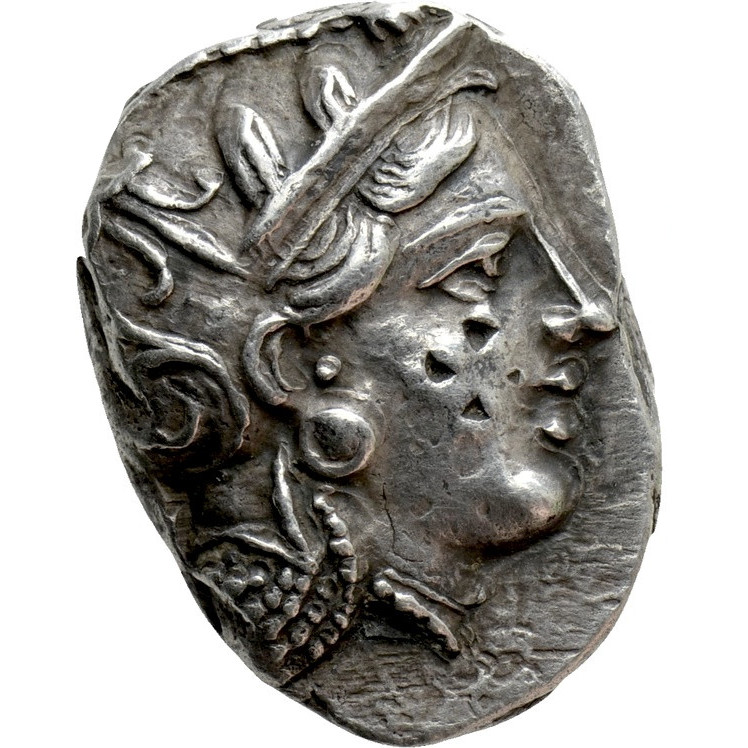
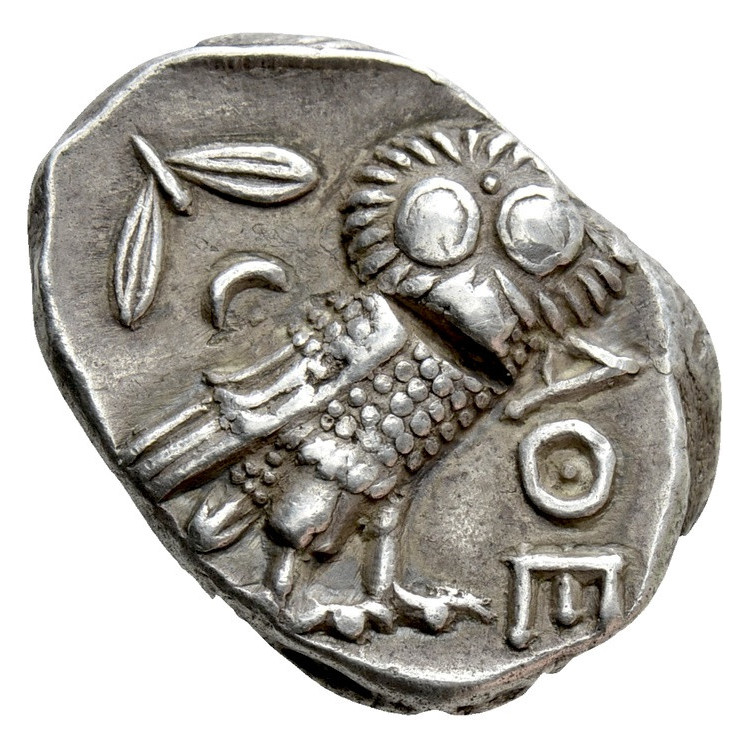
Whatever the exact reasons, Athens eventually began another large-scale production of its famous silver tetradrachms. This time, however, the traditional design was significantly updated. The most noticeable change appeared on Athena's helmet, where the floral ornament developed a distinctive pi-like form 3. Production of these so-called pi-style owls reached an enormous scale. As with the later fifth-century owl tetradrachms, so many coins were struck that no scholar has yet attempted a complete die study of the entire series.
But why is this coin called a pi-style Athenian tetradrachm?
Take a close look at Athena's helmet on the obverse. The term pi-style refers to the floral helmet ornament, which resembles the Greek letter pi (π). The ornament is divided by a long central tendril, creating the characteristic shape from which the series takes its modern name.
There are also several other differences compared with the Athenian tetradrachms of the fifth century BC. Athena's face is more refined and naturalistic on the pi-style tetradrachm. The most distinctive features are the fully profile eye and the more naturally rendered ear, both of which mark an important stylistic development from the earlier Classical owl coinage. The pi-style tetradrachm was therefore a new version of the traditional Athenian owl, with several clear changes in style.
References
- Kroll, J. H. "Athenian Tetradrachm Coinage of the First Half of the Fourth Century B.C." Revue Belge de Numismatique 157: 3–26. ↩
- Kallet, Lisa, and John H. Kroll. The Athenian Empire: Using Coins as Sources. Cambridge: Cambridge University Press, 2020, p. 135. ↩
- Metcalf, William E. (ed.). The Oxford Handbook of Greek and Roman Coinage. Oxford: Oxford University Press, 2012. ↩
Created May 8, 2026 · Updated August 25, 2026
View related coin